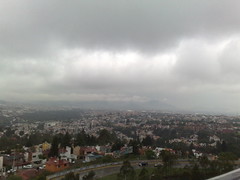
Summer in the central Mexican plateau tends to be rather rainy after a certain point in June, and this time it was no exception. With two to three tropical storms and hurricanes hitting the Mexican coasts during that time, the amount of rain was something I was not used to anymore, as you can see below:
I have been to different sporting events, but lucha libre in Mexico City is more than that. The masks, the chanting and the elaborate tricks show a lot about Mexican culture, if you care to dig a little.
It also helps that it’s a lot of fun to watch live: not only for the performers, but especially for the audience.
Update: I followed my own advice and dug a little about the cultural impact of lucha libre. I found this video (unfortunately only in Spanish) of a documentary on lucha libre. I bumped into another interesting clip explaining lucha libre in an article reviewing a recent performance in London. However, you might get an idea by watching this very amusing music video:
The lack of posts during July was caused by a well-deserved holiday in Mexico (pictures, videos) and subsequent return and catch up with work.
One thing that surprised me quite a bit on this last visit was the amount of new shopping centres opening in the city, and the amount of people visiting them not only for the sights but also with plenty of full shopping bags regardless of the fact that it was indeed that time of the year when sales and discounts are in full-force.
Given that and the strength of the superpeso (which is now trading at record highs against the dollar and has also gained against the euro) I saw a rather optimistic picture of the Mexican economy. Let’s hope it lasts given the U.S slowdown.
So, last night Spain were crowned (fairly) as champions of Europe. This tournament, in my opinion, was much, much better than 2004 in the sense that attacking football was rewarded, not only for the Spanish, but also for the Turkish, Russian, Dutch, Portuguese and even for moments German teams.
Pity we can’t have this kind of quality football every day.
Especially for people not used to it, the Finnish holiday season is quite an experience, if for nothing else, for its length.
Here in Finland, people take 4 weeks during July, which means that during this month the whole country is basicaly closed for business. This is the time when summer trainees and skeleton crews are responsible for the continued functioning of the nation while the majority spend their weeks in a summer cabin in the middle of the forest, preferrably next to a lake, but maybe without running water or electricity.
So far north the seasonal changes are very, very obvious indeed, especially in relation to the amount of light you get depending on the time of the year. During the summer equinox we get almost 19 hours of non-stop sun (if it’s sunny, that is), whereas in the darkest part of winter we have only around 6 hours.
These changes mean that also the seasons have very defined looks to them: summer is very green, autumn has two defined phases: ruska and dark and muddy, winter (if lucky) is white with snow and the spring then sees the melting of the snow and the greening of the land. The Finns also change quite a bit, as any local will tell you.
The BBC has a hilarious list of office jargon used at workplaces around the world. Any of the regular readers of now-jailedMartin Lukes will definitely appreciate it.