Category Archives: in english

The power of the community: Case SimCity 4

I grew up playing SimCity, as I’m sure some of you did.  The appeal of simulating how a city would grow and try to create something that would reflect my own choices was definitely very strong.  The last version of the franchise SimCity 4 was released in 2004, and its publisher (EA) has pretty much discontinued support for the game and stopped any sequels.

Imagine my surprise when I found Simtropolis.com, an online community of SimCity players.  Not only do they have City blogs and chat, but a huge archive or user-generated content to improve your experience of the game.  Over the years, the users have created maps (so that you can build your city in the site of Helsinki, for example), landmarks (like the Angel of Independence from Mexico City or the Atomium from Brussels) that you can use in the city you build and other general improvements to the game that the designers hadn’t originally thought of, an example of which you can find below.

It is amazing how much people can do, when you give them means to do it.  A community of devoted fans is all you need.

Recommended book: The age of the unthinkable

You know that the times are a-changin’ when terrorists armed with paper cutters are a serious menace to the world’s largest superpower, unpaid networks of developers can build an operating system that is now used in enterprise-grade IT solutions and when strategies designed to erradicate a problem such as terrorism or poverty add more fuel to the fire.  While this book is geared towards an American audience and focuses on the ramifications  of this phenomenon in foreign policy, I have been thinking about what kind of lessons this can provide business.

The author introduces in this book the concept of resilience, where instead of trying to have grand monolithic strategies to anticipate every single scenario we should instead focus on having different approaches towards a problem, “gardening” our way to ride the ever-coming waves of change and take advantage of them.  This idea resonates on many levels with many concepts I use as part of my daily life, which I will make a list of (and no, I’m not Chinese =P):

  • One of the main lessons in aikido, which is using the forces of others to your own advantage.  You don’t oppose a force with another force, you channel it so that it goes where you want to.
  • Systems intelligence, where an individual accepts that life is a set of interdepentent relationships where there are feedback mechanisms that can be tweaked to one’s own advantage with huge effects due to the non-linear character of the system.
  • Social mediatechnological convergence, creativity and other related professional interests of mine.

The interesting conclusion to which the author arrives, which I also find very appealing, is the need for empowering diverse change agents who can drive different approaches to solving a problem to work as a sort of “immunity system” for an organisation, be it a country, a company or the world.

It’s not a complicated book (in reality, I found it a little bit too light as I would have wanted a few more examples from other fields and more detail on the conceptual framework) but definitely a recommended read.

Let’s have fun with the Finnish language, part I

Over the years I’ve learned to accept as normal the many differences and quirks Finnish has for someone learning it as a second language. Some of the most hilarious I’ve seen or heard from others below:

Olen iloinen = I’m happy
Olen loinen = I’m a parasite

Minä välitän sinusta = I care about you
Minä valitan sinusta = I (will) complain about you

Minun kieli on turvonnut = My tongue is swollen
Minun kulli on turvonnut = My dick is swollen (happened to a guy who had just gotten a tongue piercing)

kolari = car crash
Kolari= town in Finnish Lapland where snow (or something like it) fell this week

Favourite sci-fi books

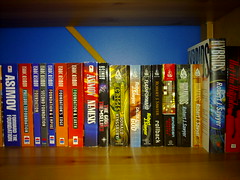
On seeing my sci-fi book collection (of which you can see but a tiny part to the right) a friend asked me what were my favourite books.  While it’s a little like asking a parent who is his/her favourite son, I do have some sci-fi books I’ve reread more than others.

  • The Gods Themselves, Isaac Asimov: Parallell universes, love and the laws of physics, what’s not to like?
  • The Mars Trilogy, Kim Stanley Robinson: The 200-year history of the colonization of Mars from arrival of the first settlers to terraformation.  Heavy on ecological, economic and sociological themes.
  • Flashforward, Robert J. Sawyer: Instead of destroying life, the universe and everything, the LHC shows the whole population of earth their selves 20 years in the future.  Now becoming a TV series.
  • The Hitchhiker’s Guide to the Galaxy (a trilogy in five parts), Douglas Adams: Spaceships, aliens and Englishmen were never so funny.
  • Spares, Michael Marshall Smith: A bleak, totally dystopian future where clones are raised to replace the body parts of the rich.
  • The Postman, David Brin: One of the biggest cinematic flops by Kevin Costner is based on a very solid post-apocalyptic novel, with survivalism as a cancer of society and the difference of science and magic being the main themes of the novel.
  • The Forever War, Joe Haldeman: War against aliens on relativistic spaceships means in Earth a 1000 years pass, while our main character ages less than a year.  A stinging commentary on the Vietnam War.
  • Space Odyssey, Arthur C. Clarke: An absolute classic. You might have probably seen the first movie, but that’s not the end of it.
  • Foundation Series, Isaac Asimov: Another classic.  The Galactic Empire is falling, and a man has foreseen it aided by the scientific approach he has created.  He cannot stop it, but he can try to alleviate it.  Eventually these books were merged with others written by Asimov, charting a fictitious human history spanning 25,000 years.
  • Dune Series, Frank Herbert: Last classic series I’ll write about here.  15,000 years of human history.  Rebellions against robot overlords, political intrigue and a big exploration of the nature of religion.
  • The Man in the High Castle, Phillip K. Dick:  The Nazis and the Japanese Empire won World War II.  The US doesn’t exist anymore, but the former axis plot against each other.
  • The Years of Rice and Salt, Kim Stanley Robinson: The black death exterminates the population of Europe, and we follow a jāti of several characters through several reincarnations until the year 1423 after Hegira (2002 A.D.).  Every chapter follows a different literary style based on literature of the culture in question.
  • The Thrawn Trilogy, Timothy Zahn:  Did you think I wouldn’t mention any Star Wars books?  The series that reignited the Star Wars franchise in the 1990’s has it all, including a memorable villain.

Any other sci-fi fans amongst my readers?  Any books/universes you’d like to add or recommend?

Commentary on the latest Mexico – USA football game

You know the result, you probably also watched the game.  The second consecutive win for Mexico against the US in just a few weeks featured this time the A squads from both sides playing at Azteca Stadium in Mexico City.

The interesting thing for me as a Mexico fan was not only the win, but the way it was achieved.  After the tactical incompetence of the Hugo Sánchez years and the endless tinkering of the Sven-Göran Eriksson times, it was nice to see a team that had a solid base of players based in Mexico and Europe who understood each other.  Furthermore, we saw that some of the U-17 champions of 2005 have made the transition to the senior team well after a shaky start.

The most important lesson, however, was the way this team finally showed (and used) the patience and maturity to win matches against hard-as-nails opposition.  While any other Mexican team would have started to panic after going one goal down against the Americans at the cradle of Mexican football, these guys kept their cool, followed their game plan, moved the ball around and finally scored.  Maybe Rafael Márquez not being there actually helped as he has a long sad history in situations like these with the national team.

El Tri wouldn’t be in this situation if it were not for the complete lack of long term planning by the Mexican Football Federation, but this victory comes at the right time to steady the ship and qualify for South Africa.  We don’t need this rollercoaster the next World Cup cycle, please.