All posts by chivacongelado

Introducing lifecasting with Ovi

Full disclaimer: this is related closely to my work.  Don’t expect me to be fully impartial.

It is still a beta and currently only works with N97, but I’ve been using it for the past week and it’s not only nice but useful.  I can’t wait to have this available for Twitter as well, but don’t expect me to divulge publicly where I or anybody else I care for exactly reside.

Helping brands think about their social media presence

My colleagues and friends Arto and Dan have been talking about their very own PESH model (participant, enabler, supplier, helper) which helps brands map their usage, presence and possible/required measurements in their social media activities.

If you do social media marketing, it would definitely help you out to check those two posts.  Definitely helps to get your ideas in order, as any good model should. 😉

Advertising that is so bad that… no, it’s not good anyway

Share photos on twitter with Twitpic

Came accross this jewel in Dan’s blog, and couldn’t help but comment on it.  With cringe-worthy photography, design that even I could do better and racist references to “African medicine men” and “Greedy Ahmed” it became one of our inside jokes on Twitter.

Don’t get me wrong, I find the idea of an advertising agency focused on SMEs appealing. I find it difficult to believe that it can’t be better executed.

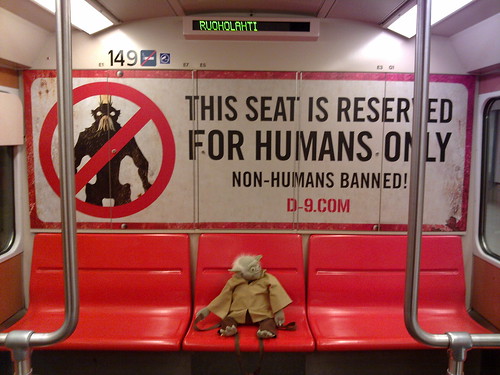
Recommended movie: District 9

Sci-fi with a strong social commentary and immigration undertones is right up my alley.  The fact that it’s set in South Africa, has great special effects and is set in a very rich and intelligent universe is of course a plus. What’s not to like? 😉 I won’t spoil the movie in the first paragraph of this blog post (you are more than able to read about it online), so go and see it. Now.

That it’s become an absolute classic of our time already 2 weeks after release doesn’t hurt. The social critique of the movie was driven home for me in a post by Inti of Alt1040 (quoted and translated below):

It is no secret that ignorance and fear easily make us racists.  The lack of knowledge of the lifestyles of people of different races and nationalities, together with the fear that we might feel for “possible” aggressions are the best nurture for intolerance […] outside of all logic and humanity.  Ignorance and fear that are themselves based in prejudice and distorted values.  When we know more about other people and find a reflection of ourselves, this fear should disappear together with any racist or xenophobic attitude.  What happens when ignorance and fear have a justification and there is no way to clear these obstacles?

Adaptation / Integration / Assimilation

Lately I’ve been meditating quite a lot on why some of my friends have not been able to fit here in Finland and left, while I am still here, going on with my life and generally happy with it.  Since some of them actually had a Finnish (or half-Finnish background) but spend their formative years abroad, I think we can safely assume that in their cases it was not due to lack of exposure to the language and culture.

I’ve also been thinking about the immigration debate in Finland, and how the desired state of all commentators (and I’d assume more than a few immigrants) is that newcomers should successfully integrate to Finnish society.  However, the question then becomes  what does integration actually mean, and how is it achieved.  With that in mind, I started to go over my own process while living here, and I have sketched a model for it with 3 different (and grossly oversimplified) stages.

  • Adaptation: The process of making terms with your new surroundings, including first contact and ways of working with the location, language, culture…
  • Integration: Now this becomes more of a two-way street.  You acquire more traits of your host society, but at the same time are accepted as part of it as well.
  • Assimilation: When there is no important difference between yourself and the society you live in.  Probably you won’t achieve it, but your kids might.

Based purely on my own observations (and taking into consideration that I am no social scientist) I am starting to believe that the biggest challenge is making the leap between adaptation and integration.  Letting go of your expectations while at the same time holding a grip on your possibilities while understanding your environment better seems to be quite hard.  Coming to terms with a language that might be very different, and values and behaviours that might not always correspond to your own, and both learn from and accept such differences requires a certain strength and a support network that not all of us have.

This is of course not helped by the fact that the phenomenon is quite new for the host society as well, which is still coming to terms with it itself.

The power of the community: Case SimCity 4

I grew up playing SimCity, as I’m sure some of you did.  The appeal of simulating how a city would grow and try to create something that would reflect my own choices was definitely very strong.  The last version of the franchise SimCity 4 was released in 2004, and its publisher (EA) has pretty much discontinued support for the game and stopped any sequels.

Imagine my surprise when I found Simtropolis.com, an online community of SimCity players.  Not only do they have City blogs and chat, but a huge archive or user-generated content to improve your experience of the game.  Over the years, the users have created maps (so that you can build your city in the site of Helsinki, for example), landmarks (like the Angel of Independence from Mexico City or the Atomium from Brussels) that you can use in the city you build and other general improvements to the game that the designers hadn’t originally thought of, an example of which you can find below.

It is amazing how much people can do, when you give them means to do it.  A community of devoted fans is all you need.