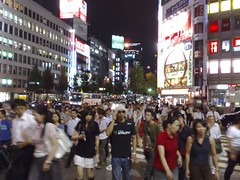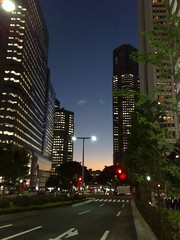
There is still a little bit of light. I really tried to get this photo right, and I’m pleased with the result.
Tokyo reminds me of Blade Runner, even though I know the design process went the other way around.
There is still a little bit of light. I really tried to get this photo right, and I’m pleased with the result.
Tokyo reminds me of Blade Runner, even though I know the design process went the other way around.
Had a business lunch yesterday here in Tokyo. During the conversation, I realised that over half of the people at the table were living in a different country where they were born: Irish, Finnish, Peruvians in Japan, Germans in China, Mexicans in Finland, etc… Those who were not living "abroad" at the moment definitely had extensive international experience.
Certainly interesting, especially since for us it was completely normal.
Como he mencionado en algún otro post, las leyes mexicanas de migración son bastante fuertes. Incluso más que las leyes de otros países como Estados Unidos, de las que tanto se quejan los medios mexicanos.
Este artículo de Sergio Sarmiento pone las cosas en perspectiva. A mí lo que me decepciona, además de la obvia cuestión de los derechos humanos, es algo más personal. Si esto es cierto entonces veo bastante difícil que me regrese a vivir a México durante mi vida productiva, ya que mi esposa no podría trabajar allá y si ella tiene que ser ama de casa se vuelve loca y me vuelvo loco yo. No me extrañaría que no fuera el único en esta situación, con lo cual México parece empeñado en perderse la oportunidad de que el know how que adquirimos en el extranjero regrese al país.
Via alt1040.
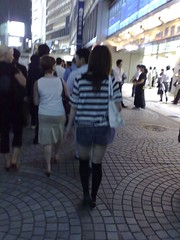
As I mentioned yesterday and you may know, Tokyo fashion is a little bit wild. Even when it isn’t, it is certainly different as the photo to the side shows.
This looks I’m sure wouldn’t work in Europe, it’s too cold and European women don’t seem to like that kind of feminity. I don’t think it would work in Latin America either, because a woman would wear a skirt instead. Only in Japan.
After around 14 months, I’m back in Japan, but this time is not on pleasure. Funnily enough, I still feel rather comfortable here as I’m also from the big city.
A couple of things that I have noticed (relevant or not) below:
* The current fashionable look for ~18 year old women is small shorts with long tights. Wouldn’t work in Finland.
* There seems to be much more contacts between Japan and China. I met in the plane a Japanese woman who is married to a Chinese man and lives in Shanghai. I’m also watching a Chinese movie subtitled in Japanese at the moment.
* Tokyo has always felt a little futuristic. Both times I’ve been here it feels I’m experiencing the future of other cities. Definitely I would like more parts of Mexico City to look like this, not just Santa Fé.
* Surprisingly enough, I feel more comfortable here than in Paris or London (even though here I don’t speak the language) only because people are more polite. The service level is also excellent compared to what you get in Europe.
* Even coming from an expensive Nordic country, shopping here is pricey.
Time to sleep for me now.
Obi's line, also mirrored in the song "There's nothing as it seems" by Pearl Jam, would very well describe something that happened to me on the way to Tokyo.
I saw a big group of Japanese senior citizens boarding the plane and immediately started thinking about writing a post about the pending Japanese demographic timebomb (and the fact that it's obvious these guys grew up cherishing the American way of life judging by how they dress). Fortunately I didn't, as their guide sat next to me. A very nice Japanese lady, who is married to a Chinese and lives in Shanghai, she explained to me that these people, all over 70, just came back from an athletics meet in Italy, where they won a few medals in for example the 10,000 metres race against peers from all over the world. They most probably are in better condition than me.
"El león no es como lo pintan"
I'll be back in writing mode when I land in my final destination. In the meantime, dear reader, you can check out my previous posts.
En mi post anterior había mencionado mis particulares ideas sobre el país y qué es lo que más me lo recuerda. En los blogs de Beco y Ceronne me encontré este video, que aunque un poco estereotípico, muestra lo que la mayoría de los mexicanos asociamos con el lugar donde nacimos.
Yo lo disfruté mucho. ¿Y ustedes?
Más fotos sobre el festejo en El Universal.
After all these years, my relationship with the country where I was born and its traditions is different from what it used to be. For example, I'm not afraid to criticise those things I don't agree, however sacred they may be.
However, that doesn't mean that I stopped feeling myself Mexican. On the contrary, I believe I'm more aware of certain aspects of our culture and am proud of it, but I've learned to keep what is worthwhile and discard the rest, which for me has had more to do with attitudes than with popular culture. I've kept the joy and the ability of improvisation, but added some further planning. I've conserved the family ties and my friends, but have become more open to new people and ideas. I've kept listening to Mexican music (traditional or otherwise) and still wear guayaberas or my tejana from time to time (in my wedding I've even used a full charro outfit), but it doesn't mean I won't use something else (Japanese yukatas are great after sauna, for example).
However, this is about Mexican Independence Day. This year I won't be able to attend the reception given by the embassy since it is on Monday and I'll be travelling, but usually I go and have a good time. My wife will represent our family. To make up for that, we decided to cook Mexican tonight and have the appropriate music with my wive's family, and it all went well. You can judge the results below.
As I've said, I'm not a typical Mexican, so what relates me to Mexico is different than otherwise would be. When I think about it, I think about my family, my friends, the food and the music. I would also like to use this occasion to remember those parts of the country we don't usually think about, like our countrymen abroad, the indigenous peoples and the immigrants to the country that are making a better life for themselves there. All these and more are also Mexico.
Este fin de semana es 16 de septiembre, la fecha en que todos los mexicanos sacamos la bandera, los trajes típicos y nuestras mejores recetas nacionales.
Hasta ahí todo bien y sin problemas, estar orgulloso de las raíces de uno es algo muy positivo. Sin embargo, algo que me preocupó bastante es una encuesta que me encontré en el Reforma, donde por desgracia se demuestra que tenemos un concepto de identidad nacional en el que no aceptamos las influencias del extranjero. La respuesta que más me pegó de la encuesta fue en donde la mayoría de los encuestados expresaban sus recelos de aquellos extranjeros que adoptaban la nacionalidad mexicana y de aquellos mexicanos que adquirían un pasaporte extranjero. Otra respuesta que me sorprendió fue aquella en la que la mayoría se expresaba contraria al comercio internacional, cuando buena parte de la economía de eso depende. En dicha encuesta también se expresaba el temor que tienen muchos mexicanos a que su identidad sea afectada porr "la globalización", y el 62% expresaban que la gente que critica al país o su forma de gobierno lo hacen porque no aman a la patria (punto que me parece en extremo incoherente, porque si por algo critico lo que veo en mi país es porque creo que se merece una mejor realidad que la que tiene).
Tal parece que queremos que el mundo se abra a México pero no que México se abra al mundo. Esto en un país que es el producto de la confluencia de culturas me parece tan contradictorio como estúpido.