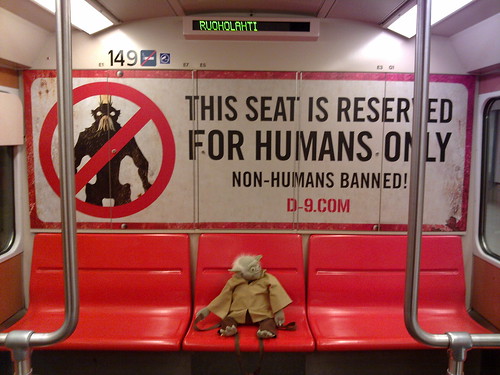
Recommended movie: District 9

Sci-fi with a strong social commentary and immigration undertones is right up my alley.  The fact that it’s set in South Africa, has great special effects and is set in a very rich and intelligent universe is of course a plus. What’s not to like? 😉 I won’t spoil the movie in the first paragraph of this blog post (you are more than able to read about it online), so go and see it. Now.

That it’s become an absolute classic of our time already 2 weeks after release doesn’t hurt. The social critique of the movie was driven home for me in a post by Inti of Alt1040 (quoted and translated below):

It is no secret that ignorance and fear easily make us racists.  The lack of knowledge of the lifestyles of people of different races and nationalities, together with the fear that we might feel for “possible” aggressions are the best nurture for intolerance […] outside of all logic and humanity.  Ignorance and fear that are themselves based in prejudice and distorted values.  When we know more about other people and find a reflection of ourselves, this fear should disappear together with any racist or xenophobic attitude.  What happens when ignorance and fear have a justification and there is no way to clear these obstacles?

Adaptation / Integration / Assimilation

Lately I’ve been meditating quite a lot on why some of my friends have not been able to fit here in Finland and left, while I am still here, going on with my life and generally happy with it.  Since some of them actually had a Finnish (or half-Finnish background) but spend their formative years abroad, I think we can safely assume that in their cases it was not due to lack of exposure to the language and culture.

I’ve also been thinking about the immigration debate in Finland, and how the desired state of all commentators (and I’d assume more than a few immigrants) is that newcomers should successfully integrate to Finnish society.  However, the question then becomes  what does integration actually mean, and how is it achieved.  With that in mind, I started to go over my own process while living here, and I have sketched a model for it with 3 different (and grossly oversimplified) stages.

  • Adaptation: The process of making terms with your new surroundings, including first contact and ways of working with the location, language, culture…
  • Integration: Now this becomes more of a two-way street.  You acquire more traits of your host society, but at the same time are accepted as part of it as well.
  • Assimilation: When there is no important difference between yourself and the society you live in.  Probably you won’t achieve it, but your kids might.

Based purely on my own observations (and taking into consideration that I am no social scientist) I am starting to believe that the biggest challenge is making the leap between adaptation and integration.  Letting go of your expectations while at the same time holding a grip on your possibilities while understanding your environment better seems to be quite hard.  Coming to terms with a language that might be very different, and values and behaviours that might not always correspond to your own, and both learn from and accept such differences requires a certain strength and a support network that not all of us have.

This is of course not helped by the fact that the phenomenon is quite new for the host society as well, which is still coming to terms with it itself.

The power of the community: Case SimCity 4

I grew up playing SimCity, as I’m sure some of you did.  The appeal of simulating how a city would grow and try to create something that would reflect my own choices was definitely very strong.  The last version of the franchise SimCity 4 was released in 2004, and its publisher (EA) has pretty much discontinued support for the game and stopped any sequels.

Imagine my surprise when I found Simtropolis.com, an online community of SimCity players.  Not only do they have City blogs and chat, but a huge archive or user-generated content to improve your experience of the game.  Over the years, the users have created maps (so that you can build your city in the site of Helsinki, for example), landmarks (like the Angel of Independence from Mexico City or the Atomium from Brussels) that you can use in the city you build and other general improvements to the game that the designers hadn’t originally thought of, an example of which you can find below.

It is amazing how much people can do, when you give them means to do it.  A community of devoted fans is all you need.

Recommended book: The age of the unthinkable

You know that the times are a-changin’ when terrorists armed with paper cutters are a serious menace to the world’s largest superpower, unpaid networks of developers can build an operating system that is now used in enterprise-grade IT solutions and when strategies designed to erradicate a problem such as terrorism or poverty add more fuel to the fire.  While this book is geared towards an American audience and focuses on the ramifications  of this phenomenon in foreign policy, I have been thinking about what kind of lessons this can provide business.

The author introduces in this book the concept of resilience, where instead of trying to have grand monolithic strategies to anticipate every single scenario we should instead focus on having different approaches towards a problem, “gardening” our way to ride the ever-coming waves of change and take advantage of them.  This idea resonates on many levels with many concepts I use as part of my daily life, which I will make a list of (and no, I’m not Chinese =P):

  • One of the main lessons in aikido, which is using the forces of others to your own advantage.  You don’t oppose a force with another force, you channel it so that it goes where you want to.
  • Systems intelligence, where an individual accepts that life is a set of interdepentent relationships where there are feedback mechanisms that can be tweaked to one’s own advantage with huge effects due to the non-linear character of the system.
  • Social mediatechnological convergence, creativity and other related professional interests of mine.

The interesting conclusion to which the author arrives, which I also find very appealing, is the need for empowering diverse change agents who can drive different approaches to solving a problem to work as a sort of “immunity system” for an organisation, be it a country, a company or the world.

It’s not a complicated book (in reality, I found it a little bit too light as I would have wanted a few more examples from other fields and more detail on the conceptual framework) but definitely a recommended read.

Let’s have fun with the Finnish language, part I

Over the years I’ve learned to accept as normal the many differences and quirks Finnish has for someone learning it as a second language. Some of the most hilarious I’ve seen or heard from others below:

Olen iloinen = I’m happy
Olen loinen = I’m a parasite

Minä välitän sinusta = I care about you
Minä valitan sinusta = I (will) complain about you

Minun kieli on turvonnut = My tongue is swollen
Minun kulli on turvonnut = My dick is swollen (happened to a guy who had just gotten a tongue piercing)

kolari = car crash
Kolari= town in Finnish Lapland where snow (or something like it) fell this week